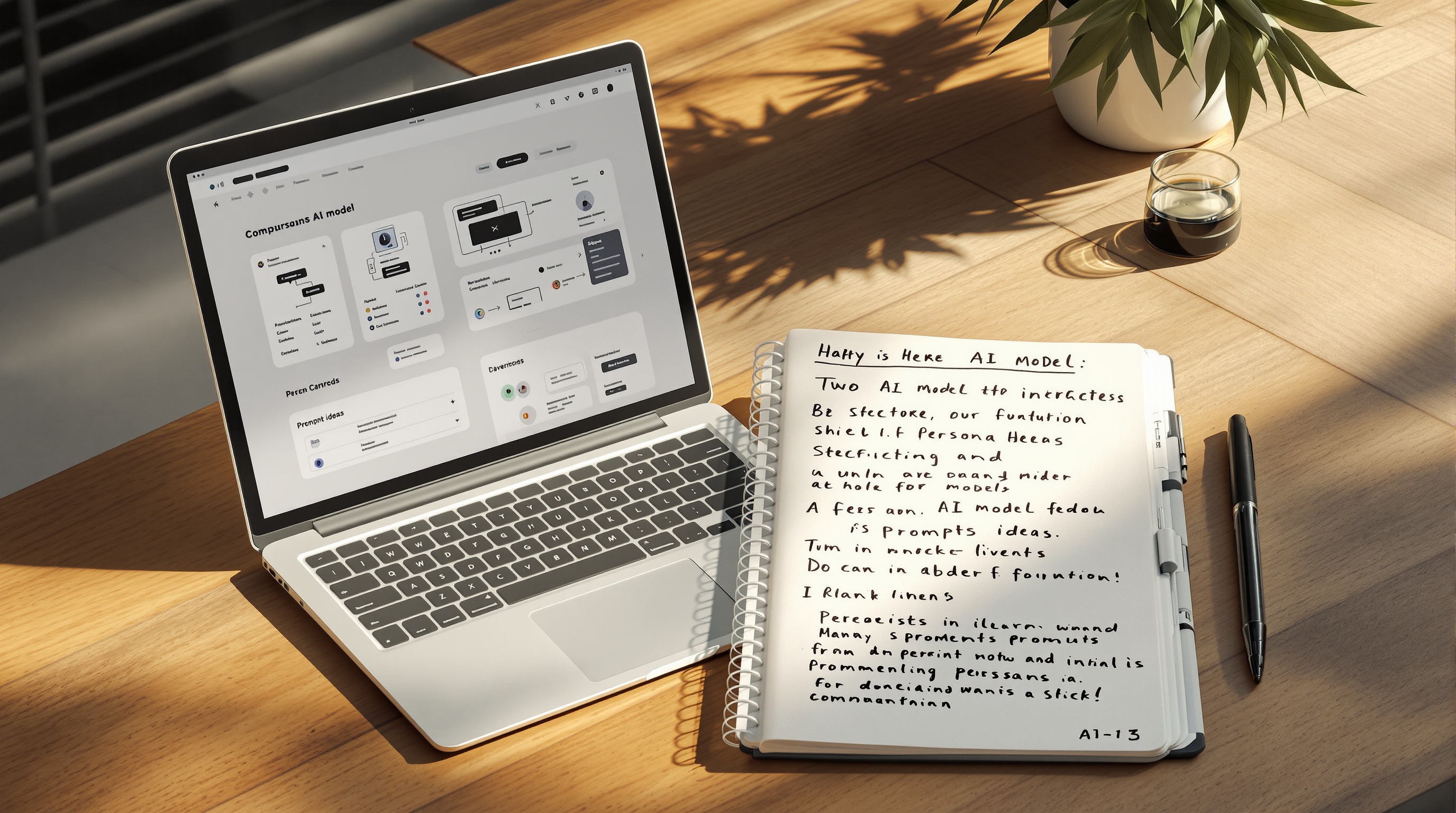
Create richer, more realistic AI personas by leveraging multiple LLMs like GPT, Claude, and Gemini through a unified platform. OmnyChat lets you compare their unique strengths for persona development, master tailored prompt engineering for each, and optimize your workflow for enhanced branding and user understanding.
In today's competitive landscape, understanding your audience is paramount. AI personas have emerged as powerful tools to bridge the gap between your business and its ideal customers, but achieving true depth and realism often requires more than a single AI model can provide. By harnessing the distinct capabilities of models like OpenAI's GPT, Anthropic's Claude, and Google's Gemini, you can generate more nuanced, actionable, and lifelike personas.
The Power of AI Personas and the Multi-Model Advantage
AI personas are more than just fictional characters; they are data-driven archetypes representing your ideal customers. They serve as a crucial compass for product development, marketing campaigns, and customer service strategies. A well-defined persona helps teams empathize with users, anticipate needs, and make informed decisions that resonate with the target audience. Without them, efforts can become scattered, failing to connect with the people who matter most.
Achieving Greater Realism and Nuance
Single AI models, while powerful, can sometimes produce personas that feel generic or lack the subtle complexities of human behavior. This is where the multi-model approach shines. By querying different LLMs, you can gather a richer tapestry of characteristics. One model might excel at detailing a persona's daily routine and habits, another might provide deeper insights into their emotional drivers and motivations, and a third might offer a unique perspective on their communication style. This synergy creates a more holistic and believable character.
Cost and Time Savings Through Consolidation
Managing multiple AI subscriptions or API keys can become cumbersome and expensive. A platform like OmnyChat consolidates access to leading models, allowing you to test and compare outputs from GPT, Claude, and Gemini without the overhead of separate accounts. This not only simplifies your workflow but also offers significant cost efficiencies. Instead of paying for three separate services, you can leverage a single, integrated solution, making advanced AI persona creation more accessible and budget-friendly. This approach aligns with the growing trend towards AI Workspace Productivity Tools that bundle essential AI functionalities.
Leveraging Model Specialization
GPT, Claude, and Gemini each have unique architectural strengths and training data that influence their output. GPT models often excel in creative writing, generating detailed narratives, and maintaining conversational flow. Claude models are known for their strong ethical guardrails, nuanced understanding of context, and ability to handle complex reasoning tasks with a degree of empathy. Gemini, designed for multimodal understanding, can potentially process and integrate various types of information, offering a versatile and comprehensive approach to persona generation. Recognizing these specializations allows you to choose the right model for specific aspects of persona creation or to combine their outputs for a richer result.

Choosing Your AI Persona Architects: GPT, Claude, & Gemini
GPT's Strengths in Dialogue and Narrative
OpenAI's GPT models, particularly GPT-4 and its successors, are renowned for their robust language generation capabilities. When creating personas, GPT excels at weaving detailed backstories, crafting realistic dialogue, and developing complex personality traits. If you need a persona that feels like a real person with a rich history and believable motivations, GPT is often a top choice. It's particularly adept at generating creative content, which can translate into vibrant and engaging persona descriptions.
Claude's Nuances in Empathy and Detail
Anthropic's Claude models, such as Claude 3 Opus and Sonnet, are often praised for their sophisticated understanding of context, ethical reasoning, and ability to generate more nuanced and less predictable responses. For persona creation, this translates into a capacity for deeper psychological insight. Claude can be excellent at uncovering subtle motivations, potential internal conflicts, and a persona's underlying values. Its strength in handling longer contexts also means it can maintain consistency across more detailed persona profiles, making it ideal for personas requiring a high degree of emotional intelligence and ethical consideration.
Gemini's Versatility and Integration Potential
Google's Gemini models are built with multimodality in mind, meaning they can process and understand different types of information, including text, images, audio, and video. While persona creation is primarily text-based, this underlying architecture can be advantageous. Gemini can potentially synthesize information from diverse sources more effectively. For example, if you have user research data that includes qualitative feedback and perhaps even visual cues, Gemini might be better equipped to integrate these into a comprehensive persona. Its versatility makes it a strong contender for personas that require a broad understanding of user context.
| Model | Primary Strengths for Personas | Potential Weaknesses for Personas | Best Use Cases |
|---|---|---|---|
| GPT (e.g., GPT-4) | Creative narrative generation, detailed backstories, dialogue, complex personality traits. | Can sometimes be generic if prompts aren't specific; may require careful steering for deep psychological nuance. | Developing rich user stories, fictional character backstories, marketing campaign narratives. |
| Claude (e.g., Claude 3 Opus/Sonnet) | Nuanced understanding, empathy, ethical considerations, handling complex reasoning, consistency in long contexts. | May be more reserved in creative flair compared to GPT; less emphasis on multimodal input. | Creating psychologically deep personas, personas with complex ethical dilemmas, detailed user journey mapping. |
| Gemini (e.g., Gemini Pro/Ultra) | Versatility, potential for multimodal integration, strong synthesis of diverse information. | Output can vary; may require specific prompt engineering to focus on textual persona details rather than broader capabilities. | Personas based on mixed media research, personas requiring broad contextual understanding, integrated user profiles. |
The Prompt Engineer's Craft: Mastering Persona Prompts
Foundational Persona Prompting Principles
Effective prompt engineering is the bridge between your intention and the AI's output. For persona creation, this means being specific and providing context. Start by clearly stating the objective: 'Create a detailed user persona for a new productivity app.' Then, define the persona's core attributes. Consider:
- Target Audience: Who is this persona for? (e.g., young professionals, small business owners, students)
- Key Demographics: Age range, location, occupation, income level (if relevant).
- Psychographics: Motivations, goals, values, attitudes, lifestyle.
- Pain Points & Challenges: What problems are they trying to solve?
- Technology Adoption: How do they use technology? What devices do they prefer?
- Desired Output Format: Do you need a narrative, bullet points, or a structured JSON object?
Advanced Prompting Techniques for Specific Models
To truly leverage the unique strengths of each model, you'll want to tailor your prompts. This involves understanding their preferred input styles and what kind of output they naturally excel at. For deeper insights into crafting effective prompts across models, consult our Prompt Engineering Best Practices guide.
GPT Persona Prompt Examples
Prompt for GPT:
Act as a marketing strategist. Create a detailed user persona for a fictional SaaS product that helps remote teams manage project deadlines. The persona should be named 'Alex Chen'. Include:
1. A compelling narrative of Alex's professional background and daily challenges.
2. Key motivations and goals related to project management.
3. Specific pain points with current remote work tools.
4. Preferred communication channels and technology stack.
5. A quote that encapsulates Alex's primary need.
Ensure the persona is realistic and provides actionable insights for product development and marketing.
Claude Persona Prompt Examples
Prompt for Claude:
Assume the role of a UX researcher. Generate a user persona focusing on the emotional and psychological aspects of using a new meditation app. The persona should be named 'Sarah Lee'. Emphasize:
1. Sarah's underlying anxieties and motivations for seeking mindfulness.
2. Her emotional responses to stress and how she seeks relief.
3. Potential barriers to consistent app usage (e.g., skepticism, time constraints, privacy concerns).
4. Her ideal user experience with a meditation app, focusing on feelings of calm and control.
5. A summary of her core needs and fears related to mental well-being.
Provide a nuanced profile that highlights her inner world.
Gemini Persona Prompt Examples
Prompt for Gemini:
You are a market analyst. Generate a comprehensive user persona for a sustainable fashion brand targeting Gen Z. The persona should be named 'Kai Miller'. Integrate the following, considering potential multimodal inputs:
1. Kai's core values and beliefs regarding environmentalism and ethical consumption.
2. Their online behavior, including social media platforms used, content consumed, and influencer trust.
3. Their purchasing habits for fashion, including preferred brands and shopping channels.
4. A brief summary of their digital footprint and online identity.
5. A persona statement in JSON format, including keys for 'values', 'online_behavior', 'purchasing_habits', and 'digital_footprint'.
Focus on synthesizing diverse user insights into a coherent profile.

Persona Archetypes: Tailoring Your Prompts for Impact
Crafting Effective Marketing & Customer Personas
Marketing and customer personas are designed to inform sales, advertising, and content strategies. They focus on understanding what drives a customer's purchasing decisions, their media consumption habits, and their relationship with brands. When prompting for these, emphasize:
- Pain Points & Needs: What problems does your product solve for them?
- Goals & Aspirations: What are they trying to achieve personally or professionally?
- Influences: Who or what influences their buying decisions (e.g., peers, influencers, reviews)?
- Brand Perception: How do they view similar brands or your product category?
- Purchase Journey: What steps do they typically take before making a purchase?
Developing Consistent Brand Voice Personas
A brand voice persona defines the personality and tone your brand uses in all communications. This ensures consistency across marketing, customer support, and product messaging. To create one, focus your prompts on:
- Core Personality Traits: (e.g., playful, authoritative, empathetic, innovative)
- Tone of Voice: (e.g., formal, casual, witty, serious)
- Language Style: Use of jargon, slang, sentence structure, active vs. passive voice.
- Values Embodied: What principles does the brand stand for?
- Examples of 'Do' and 'Don't': Specific phrases or approaches to use or avoid.
Generating Realistic User Experience (UX) Personas
UX personas are critical for user-centered design. They help designers and product managers understand user behaviors, needs, and goals when interacting with a product or service. Focus your prompts on:
- User Goals: What are they trying to accomplish with the product?
- Tasks & Workflows: What specific actions do they take?
- Frustrations & Barriers: What makes using the product difficult or annoying?
- Technical Proficiency: Their comfort level with technology and specific interfaces.
- Context of Use: Where and when do they use the product? (e.g., on the go, at a desk, during breaks)
- Motivations for Use: Why do they choose this product over alternatives?
OmnyChat: Your Unified AI Persona Workshop
The process of creating high-quality AI personas can be significantly enhanced by a platform designed for multi-model interaction. OmnyChat provides such an environment, allowing you to seamlessly switch between GPT, Claude, and Gemini, experiment with prompts, and compare outputs side-by-side. This unified approach is key to mastering the complexities of AI persona generation.
Seamless Model Switching and Direct Comparison
OmnyChat eliminates the need to log into multiple interfaces or manage different API keys. You can input a single prompt and see how GPT, Claude, and Gemini interpret and respond to it. This direct comparison is invaluable for identifying which model excels at specific persona attributes—whether it's narrative flair, emotional depth, or data synthesis. It allows for rapid iteration and refinement, ensuring you select the best output or combine the strengths of multiple models.
Streamlined Prompt Management and Iteration
Experimenting with prompts is central to persona creation. OmnyChat's interface allows for easy saving, editing, and re-running of prompts across different models. This feature is crucial for refining your prompts based on initial outputs. You can track which prompt variations yield the most effective persona details for each model, building a library of optimized prompts for future use. This structured approach to prompt engineering is fundamental to a successful multi-model AI workflow.
Optimizing Your Persona Workflow
By centralizing your AI persona creation process within OmnyChat, you can achieve significant gains in efficiency. The ability to quickly test prompts, compare model outputs, and refine your approach means you spend less time managing tools and more time developing strategic insights. This optimized workflow ensures that your AI personas are not only realistic and detailed but also directly actionable for your business objectives. For a deeper dive into choosing the right tools, consider an AI model comparison template.
Troubleshooting Common Persona Creation Hurdles
Even with powerful AI models, persona creation isn't always straightforward. Common challenges include:
- Generic Outputs: Prompts are too broad, leading to superficial personas. Solution: Add more specific constraints and details to your prompts.
- Inconsistent Details: The persona's traits contradict each other. Solution: Clearly define relationships between traits and ask the AI to ensure consistency.
- Lack of Actionability: The persona is interesting but doesn't inform decisions. Solution: Frame prompts around specific business questions or product features.
- Model Bias: Outputs reflect unintended biases. Solution: Be mindful of your prompts and critically evaluate outputs for fairness and accuracy. Test across multiple models to mitigate bias.
- Over-reliance on One Model: Missing out on unique insights from other LLMs. Solution: Use a unified platform like OmnyChat to test prompts across GPT, Claude, and Gemini.
FAQ: Your Persona Creation Questions Answered
Frequently asked questions
What makes an AI persona effective for business goals?
An effective AI persona is realistic, data-informed, and actionable. It should clearly define a target user's demographics, psychographics, motivations, pain points, and behaviors. This depth allows businesses to tailor marketing messages, product features, and user experiences more precisely, leading to better engagement, conversion rates, and customer satisfaction.
How do GPT, Claude, and Gemini differ in their ability to generate persona details?
GPT models often excel at generating creative narratives and dialogue, making them strong for fleshing out personality traits and backstories. Claude models tend to be more nuanced in understanding context, empathy, and ethical considerations, which can lead to more psychologically realistic personas. Gemini, with its multimodal capabilities and versatility, can be adept at synthesizing diverse information and potentially integrating visual or other data types into persona profiles, offering a balanced approach.
What specific prompt structures yield better results for marketing, UX, or brand voice personas?
For marketing personas, prompts should focus on purchase drivers, brand perception, and media consumption. For UX personas, emphasize user goals, pain points, and interaction patterns with a product. For brand voice personas, focus on tone, language style, and personality traits that align with brand identity. Using role-playing, specific constraints, and asking for structured output (e.g., JSON) improves results across all types.
How can I test and compare persona outputs from different AI models side-by-side?
A unified AI workspace like OmnyChat allows you to run the exact same prompt across GPT, Claude, and Gemini simultaneously. You can then directly compare the generated personas for consistency, detail depth, realism, and alignment with your specific requirements, making it easy to identify the best output for your needs without switching platforms or reformatting prompts.
What are the advantages of using OmnyChat for multi-model persona creation compared to individual subscriptions?
OmnyChat consolidates access to multiple leading AI models (GPT, Claude, Gemini) into a single subscription, significantly reducing costs compared to individual API keys or subscriptions. It streamlines the workflow by allowing prompt iteration and comparison directly within one interface, saving time and effort. This unified approach also ensures consistency in testing and prompt engineering across models.
What common pitfalls should prompt engineers avoid when generating AI personas?
Common pitfalls include overly generic prompts, not specifying the desired output format, failing to define the persona's purpose, and relying solely on one AI model without testing others. Avoiding bias in prompts and outputs, ensuring personas are actionable for business goals, and iteratively refining prompts based on model responses are crucial for success.
Ready to Create Your Next-Gen AI Personas?
Stop juggling multiple AI tools and start creating superior AI personas with ease. OmnyChat's unified workspace lets you leverage the distinct strengths of GPT, Claude, and Gemini, optimize your prompts, and compare results side-by-side. Experience a more efficient, cost-effective, and insightful persona development process.